




383 Stroker Engine: Specs, Horsepower, Kits and Crate Engines
A 383 stroker is a small block Chevy 350 fitted with a 3.750″ stroke crankshaft instead of the 350’s 3.480″ crank, usually with the cylinders bored 0.030″ oversize to 4.030″. The longer stroke and slightly larger bore raise displacement to about 383 cubic inches, which adds torque across the rev range while the engine keeps the external size and mounting points of a 350. That makes it one of the most popular ways to get more power from a small block Chevy.
How a 350 becomes a 383
V8 displacement is bore x bore x stroke x 0.7854 x 8. The 3.750″ stroke is the stroke of Chevy’s factory 400 small block, and the combinations work out like this:
| Bore | Stroke | Displacement |
|---|---|---|
| 4.000″ (standard 350 bore) | 3.480″ (stock 350) | about 350 ci |
| 4.000″ | 3.750″ | about 377 ci |
| 4.030″ (0.030″ over) | 3.750″ | about 383 ci |
| 4.060″ (0.060″ over) | 3.750″ | about 388 ci |
“383” has become the general name for this stroker, so check the actual bore of any engine you compare. BluePrint, for example, notes that its BP38318 series 383s use a true 4.000″ bore and 3.750″ stroke, which works out to 377 cubic inches. For more on bore, stroke and other popular strokers, read what a stroker engine is.
383 vs 350
| 350 small block | 383 stroker | |
|---|---|---|
| Stroke | 3.480″ | 3.750″ |
| Typical bore | 4.000″ | 4.000″ to 4.030″ |
| Displacement | 350 ci (5.7L) | 377 to 383 ci |
| Block and mounts | Small block Chevy | Same block and mounts |
| Our BluePrint crate engine ratings | 341 and 390 HP | 436 and 445 HP |
The 383 makes more torque for the same external size, which suits heavier cars, trucks and street engines that spend most of their time at low and mid RPM. The 350 costs less and needs fewer special parts. See our Chevy 350 engine guide for the 350’s specs and horsepower by year.
How much horsepower does a 383 stroker make?
It depends far more on the cylinder heads, camshaft, compression and induction than on the crankshaft. In our range:
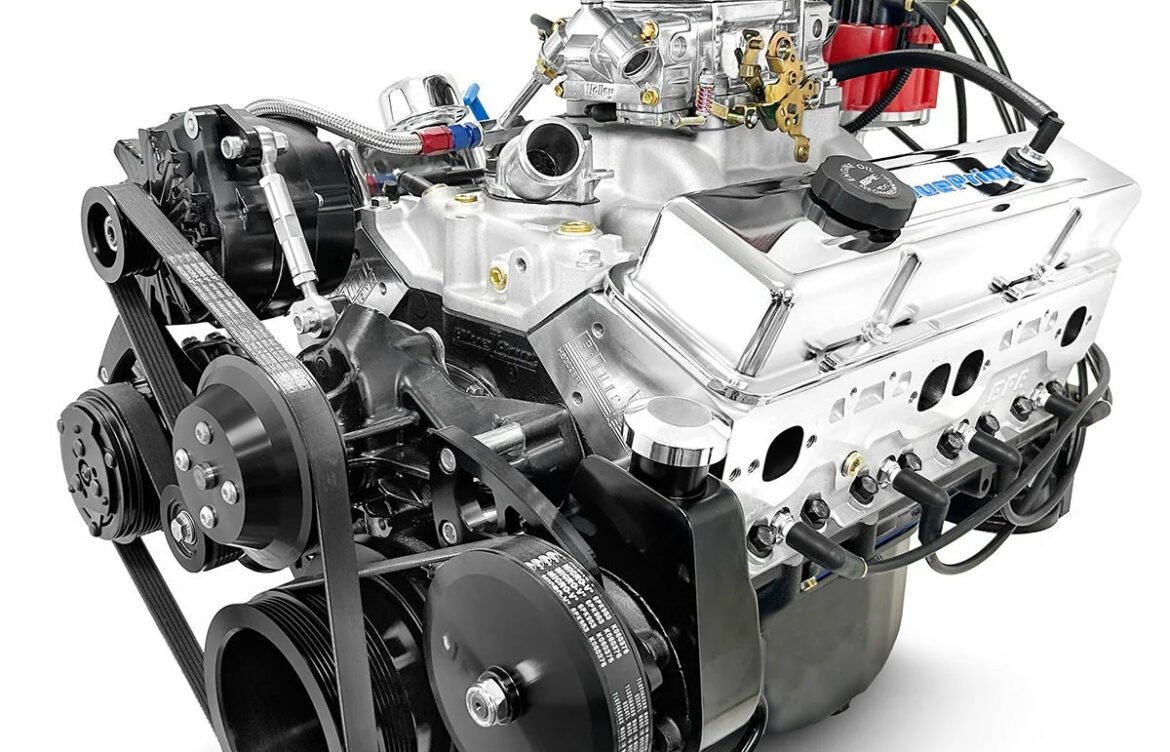
- BluePrint 383, 436 HP: 443 lb-ft, 10:1 compression, aluminum heads and intake, hydraulic roller cam. Check package contents and ratings against each exact part number. For a base-dressed option, see our BP38318CTC1 listing rather than assuming all dressing levels are interchangeable.
- BluePrint 383, 445 HP (BP38317CT1).
- Quicksilver QS 383 CT: a factory-sealed circle-track engine rated at 400 HP and 440 lb-ft, with a forged crankshaft.
See all of them in small block Chevy crate engines.
Building a 383 from a stroker kit
A 383 stroker kit, or rotating assembly, contains the 3.750″ stroke crankshaft, connecting rods and pistons sized for your bore, and is often balanced as a set. Our Eagle SBC 383 stroker rotating assembly has a cast crankshaft, forged pistons for a 4.030″ bore and 5.700″ I-beam rods, balanced. The Eagle SBC 388 stroker assembly uses the same 3.750″ stroke with hypereutectic pistons for a 4.060″ bore. See all stroker kits and rotating assemblies.
A kit is only part of the job. Plan for:
- Machine work: boring and honing the block to the piston size, and balancing if the kit is not supplied balanced for your parts.
- Clearance checks: the longer stroke brings the connecting rods closer to the bottom of the cylinders and the camshaft, so a machinist checks rod-to-block and rod-to-cam clearance, and some blocks need light grinding.
- Matching parts: the harmonic balancer and flywheel or flexplate have to match the kit’s balance (internal or external), and the camshaft, heads and compression should suit the extra displacement.
- Assembly: follow the kit and component manufacturers’ specifications for clearances and fastener torque.
Stroker kit or 383 crate engine?
A kit makes sense if you already have a good 350 block and access to a machine shop. A crate engine arrives assembled by the manufacturer with a published rating and a known parts list, which saves machine work and time. Our guide to long block vs short block explains what each dressing level includes.
Not to be confused with the Chrysler 383
Chrysler built a factory 383 cubic inch big block V8 in the 1960s. It is a completely different engine from the small block Chevy 383 stroker described here.
Compare listed BluePrint engine packages
These listings have different included parts. Check each product description and confirm fitment before choosing a package.
- BluePrint BP38318CTF1: base dressed engine.
- BluePrint BP38318MPFID: EFI dressed engine.
- BluePrint BP38318MPFIK: EFI dressed engine with pulleys.
- BluePrint BP38318MPFIKB: EFI dressed engine with pulleys.
Frequently asked questions
Is a 383 a 350?
A 383 stroker is built from a small block Chevy 350 block. It keeps the 350’s external dimensions and mounting points but uses a longer-stroke crankshaft and, usually, a slightly larger bore.
How much horsepower does a 383 stroker have?
The 383 crate engines we sell are rated from 400 HP (Quicksilver QS 383 CT) to 436 HP and 445 HP (BluePrint). Home-built 383s vary widely with the heads, camshaft and induction.
What is in a 383 stroker kit?
A 3.750″ stroke crankshaft, matching connecting rods and pistons, and often rings and bearings. The Eagle 383 kit we stock uses forged pistons for a 4.030″ bore and 5.700″ rods, and is balanced.
What is the difference between a 383 and a 388 stroker?
Both use a 3.750″ stroke. The 388 has a 4.060″ bore (0.060″ oversize) instead of 4.030″, which adds about five cubic inches.
Is a 383 stroker reliable?
A well-built 383 with matched, balanced parts and checked clearances is a dependable street engine, which is why it is so popular. Reliability comes from the quality of the parts and the machine work rather than the stroke itself.
Is a 383 or a 454 better?
Neither is better in general. A 383 is a stroked small block that keeps the small block’s external size, while a 454 is a big block with more displacement and a larger, heavier block. In our range the BluePrint 383s are rated 436 to 445 HP and the 454s 438 HP (GM 454 HO) to 460 HP (BluePrint), so peak ratings are close; the choice comes down to the engine bay, the vehicle and the torque you want. See big block vs small block and our best crate engine guide.
Is a 383 stroker better than an LS engine?
Neither is better in every car. The BluePrint 383 crate engines we list are rated at 436 to 445 HP and fit the mounts of a small block Chevy, so they suit classic cars built around one. An LS3 is rated at 430 HP, or 495 HP in the hot-cam version, has an aluminum block and heads and is designed for port fuel injection, but an older car needs LS mounts, wiring and an ECU to run it. For a small block Chevy car the 383 is the simpler swap; for a modern EFI build the LS usually makes more sense. See our LS3 engine guide.
Related: what is a stroker engine, SBC firing order, crate engine prices, 383 stroker crate engines, Chevy 350 engine, lobe separation angle, compression ratio, all guides.
Comments