





Carburetor vs Fuel Injection: Which Is Better for Your Crate Engine?
A carburetor mixes fuel into the incoming air mechanically, using the vacuum created by airflow. Electronic fuel injection (EFI) sprays a precisely metered amount of fuel, controlled by a computer that reads engine sensors. EFI generally gives easier cold starts, smoother drivability and better fuel economy. Carburetors are simpler, cheaper and easier to work on without electronics.
How a carburetor works
Air flowing through the carburetor’s venturi creates low pressure that draws fuel through calibrated jets. Jetting, accelerator pump and choke settings tune the mixture. There is no computer: changes are made by swapping parts and adjusting by hand. Small engines still rely on carburetors too: our 50cc kid kart engine is sold as a package that includes its carburetor.
How fuel injection works
An EFI system uses a high-pressure fuel pump and injectors, with an engine control unit (ECU) that reads sensors such as oxygen, throttle position, air temperature and engine speed. It adjusts the fuel delivered many times per second, and it can correct for altitude, temperature and engine load automatically.
Carburetor vs fuel injection: pros and cons
| Carburetor | Fuel injection (EFI) | |
|---|---|---|
| Cost | Lower upfront cost | Higher cost: injectors, ECU, high-pressure pump |
| Cold starts and drivability | Needs a choke and warm-up; affected by weather and altitude | Consistent starts; adjusts automatically |
| Fuel economy | Usually lower | Usually better |
| Tuning | Mechanical: jets, springs, adjustments | Electronic: laptop or handheld tuning |
| Fuel system | Low-pressure pump | High-pressure pump, regulator and suitable lines |
| Looks and originality | Period-correct for classic cars | Modern; some systems imitate a carburetor’s look |
Choosing a carbureted or EFI crate engine
Many crate engines come either way. BluePrint, for example, offers its SBC 350, 383, 400, BBC 454 and SBF 302 engines in carbureted and EFI versions. Choose carbureted for a classic car, a simpler install or a period look. Choose EFI if you want modern drivability and are ready to fit a high-pressure fuel system. Check whether the engine controller is included, because some EFI listings say it is sold separately.
Browse small block Chevy, big block Chevy and small block Ford crate engines, all in carbureted and EFI versions, or see Haltech engine management for a standalone ECU (the Elite 1500 we list is a 4-cylinder and 2-rotor unit, so check cylinder support before planning it for a V8).
Throttle body EFI vs multi-port injection
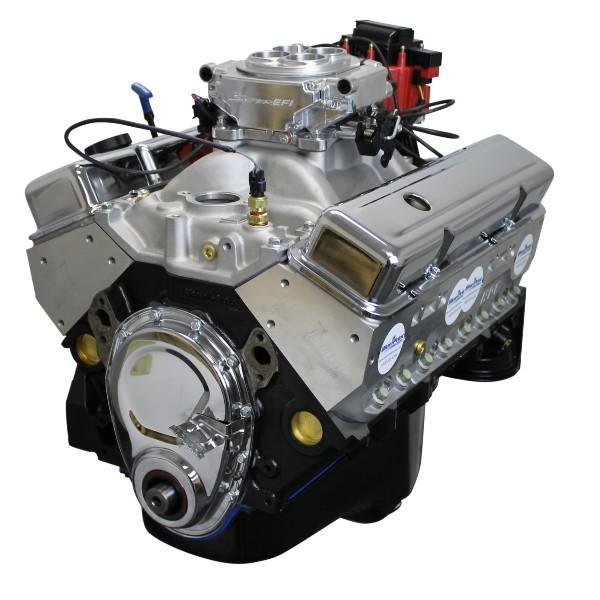
Many EFI systems sold for carbureted engines are throttle body injection (TBI): a unit that bolts on where the carburetor goes and sprays fuel above the throttle plates, so it installs much like a carburetor. Multi-port injection puts one injector at each intake port, close to the valve, for more precise fuel delivery to each cylinder; modern factory engines such as the LS3 and Coyote use port or direct injection. BluePrint’s SBC 400 EFI (500 HP, BP4002CTF), for example, comes with a Holley Sniper EFI system, a self-tuning throttle body unit.
EFI crate engines we stock
24 of our crate engine listings carry EFI in their title. Modern engines such as the Coyote and LT4 are fuel-injected by design and are not counted here.
| EFI version | Listings | Price |
|---|---|---|
| Small block Chevy 350 EFI | 5 | $6,549 to $9,099 |
| Small block Chevy 383 EFI | 3 | $7,999 to $10,049 |
| Small block Chevy 400 EFI | 1 | $8,999 |
| Big block Chevy 454 EFI | 3 | $10,999 to $13,049 |
| Small block Ford 302 EFI | 6 | $7,699 to $10,199 |
| Small block Ford 347 EFI | 1 | $8,999 |
| GM LS 376 EFI (BluePrint) | 2 | $11,149 to $12,560 |
| 426 Gen III Hemi EFI | 3 | $16,899 to $26,799 |
Prices are taken from the live product pages and change from time to time. Most of the small block and big block engines in this table are also listed in carbureted versions, so compare them in each category. See crate engine prices for every engine family.
Frequently asked questions
Is fuel injection better than a carburetor?
For most street driving, EFI is easier to live with: better starts, smoother running and better economy. A well-tuned carburetor can make similar power and is simpler and cheaper, which is why carbureted crate engines are still popular for classic builds.
Can I convert a carbureted crate engine to EFI later?
Often yes, with an intake and injection system or a throttle-body EFI kit, plus an EFI fuel pump and lines. Starting with the EFI version of the engine is usually simpler.
Do EFI crate engines need a high-pressure fuel pump?
Yes. Fuel injection runs at much higher pressure than a carburetor and needs a pump, filter and regulator designed for EFI.
Is throttle body injection better than a carburetor?
For drivability on most street engines, yes: a throttle body EFI adjusts itself for temperature and altitude and starts more easily. A carburetor costs less and needs no electronics. Multi-port injection meters fuel more precisely than either.
Planning a swap? Read the LS swap guide and what a crate engine is.
Comments