





Lobe Separation Angle Explained: Cam Lift, Duration and LSA
Lobe separation angle (LSA) is the angle, in camshaft degrees, between the centerline of the intake lobe and the centerline of the exhaust lobe for the same cylinder. A narrower LSA increases valve overlap for a rougher idle and a stronger, narrower power band, while a wider LSA reduces overlap for a smoother idle and a broader power band.
What do lift, duration and lobe separation angle mean?
| Spec | What it measures | What more of it does |
|---|---|---|
| Lift | How far the valve opens, in inches | More airflow, as long as the heads flow at that lift and the springs and piston clearance allow it |
| Duration | How long the valve stays open, in crankshaft degrees | Moves the power band higher in the RPM range; softens low-RPM torque and idle |
| Lobe separation angle | The spacing between intake and exhaust lobes, in camshaft degrees | Wider: smoother idle, more vacuum, broader power. Narrower: more overlap, lopey idle, peakier power |
What is the difference between advertised duration and duration at .050 inch?
Duration is quoted two ways:
- Advertised duration is measured from a very small lifter rise that differs between cam makers.
- Duration at .050 inch is measured once the lifter has risen fifty thousandths of an inch, which makes it the fairer figure for comparing cams.
When two numbers appear, such as 236/242, the first is the intake lobe and the second the exhaust.
What is the difference between lobe lift and valve lift?
The cam lobe moves the lifter a certain distance (lobe lift), and the rocker arm multiplies it: valve lift = lobe lift x rocker ratio. A cam listed with .555 inch valve lift assumes a specific rocker ratio, so changing rocker arms changes the lift at the valve. Roller cams can reach high lift with less duration than flat tappets; see roller cam vs flat tappet.
What does lobe separation angle change?
| Narrow LSA (about 106 to 110) | Wide LSA (about 112 to 116) | |
|---|---|---|
| Valve overlap | More | Less |
| Idle | Rougher, the classic lope | Smoother |
| Idle vacuum | Lower | Higher, which helps power brakes |
| Power band | Narrower, with a stronger mid-range peak | Broader and flatter |
| Typical use | Carbureted street/strip and race engines | EFI engines, daily drivers, supercharged and turbocharged engines |
These are tendencies, not rules: the same LSA behaves differently with more or less duration, and displacement matters too, because a large engine tames a cam that would be rough in a small one.
LSA, overlap and intake centerline
Overlap is the period around top dead center when the intake and exhaust valves are both open. It can be estimated in crankshaft degrees as (intake duration + exhaust duration) / 2 minus (2 x LSA). More duration or a narrower LSA both add overlap.
Intake centerline is a different measurement: it is where the installer positions the cam relative to the crankshaft, and it can be advanced or retarded a few degrees when the cam is degreed in. LSA is fixed by the grinder; intake centerline is set at installation.
Cam specs of current crate engines
| Engine | Valve lift, intake/exhaust (in.) | Duration at .050, intake/exhaust | Rated power |
|---|---|---|---|
| GM Performance 6.0L LS364/450 | 0.550 / 0.550 | 204 / 218 | 452 HP |
| GM Performance LSX 376-B15 | .560 / .555 | 210 / 230 | 473 HP |
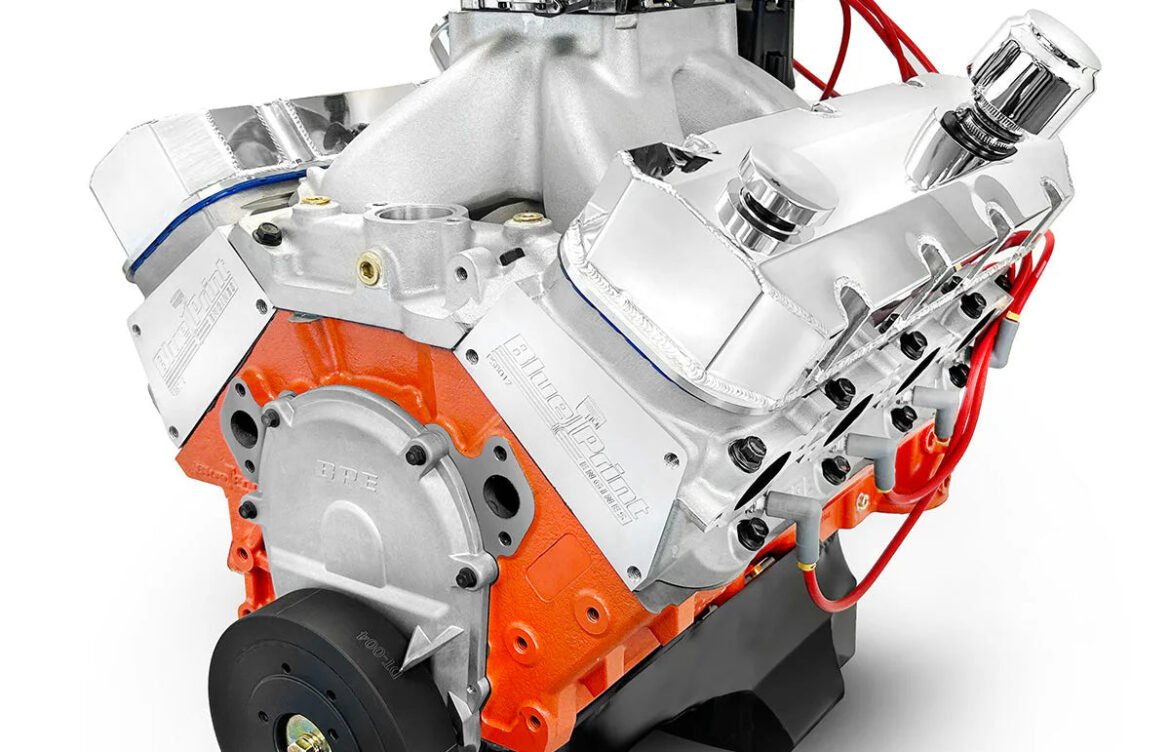
| BluePrint SBC 400 | .555 / .576 | 236 / 242 | 500 HP |
| BluePrint SBF 408 | .579 / .579 | 236 / 248 | 450 HP |
| BluePrint BBC 632 | .698 / .698 | 272 / 282 | 815 HP |
Figures are from each product’s own description. Of these listings only the BluePrint 632 states a lobe separation: 110 degrees. Using the estimate above with its .050 inch figures, (272 + 282) / 2 minus 220 gives about 57 degrees of overlap at .050 inch, a race-style cam for a 632 cubic inch engine. The mild 204/218 cam in the 6.0L LS sits at the other end of the scale. Most crate engine listings do not publish full cam cards, so ask the manufacturer if you need the LSA of a specific engine. Browse all crate engines.
How do I choose cam specs for a street engine?
- Match duration to the RPM range the engine will really use, the vehicle weight, the gearing and the torque converter.
- Power brakes, air conditioning, automatic transmissions and EFI all favor more vacuum, which means less overlap.
- More duration generally wants more compression ratio to keep low-RPM torque.
- Use the valve springs the cam maker specifies for the lift and lobe design.
A crate engine removes this guesswork, because the cam, heads, compression and induction are chosen and tested as a package.
Frequently asked questions
What is lobe separation angle on a cam?
The angle in camshaft degrees between the intake and exhaust lobe centerlines for one cylinder. It controls how much the two valve events overlap.
Is a 110 or 114 lobe separation angle better for the street?
A 114 degree cam generally idles more smoothly, makes more vacuum and has a broader power band. A 110 degree cam generally has more overlap, a choppier idle and a stronger mid-range. Which suits an engine depends on its duration, displacement and use.
What gives a cam a lopey idle?
Valve overlap. Long duration and a narrow lobe separation angle both increase it, which lets some exhaust dilute the incoming charge at idle.
What does duration at .050 mean?
The number of crankshaft degrees the lifter is raised at least .050 inch off the base circle. It is the standard figure for comparing cams from different makers.
Is lobe separation angle the same as intake centerline?
No. LSA is ground into the cam. Intake centerline describes where the cam is installed relative to the crankshaft and can be adjusted slightly.
Related: roller cam vs flat tappet, compression ratio, horsepower vs torque, engine break-in, 383 stroker, all guides.
Comments