





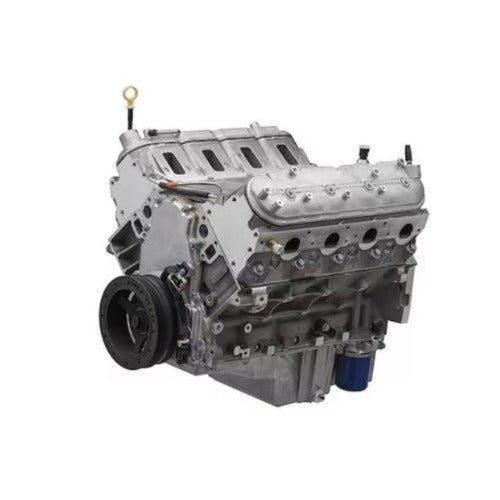
LS Swap Guide: What You Need for a GM LS Engine Swap
An LS swap means installing a GM LS-series V8 in a vehicle that did not come with one. LS engines are popular swap choices because they are compact for their displacement, make strong power and torque, and have huge aftermarket support. A successful swap comes down to planning the systems around the engine: mounts, oil pan, accessories, engine management, fuel and exhaust.
1. Choose the engine
The engine sets the budget and the power level. Common choices include:
- LS3 (6.2L, 376 ci): offered as a crate engine at 430 HP and 495 HP, in long-block and complete form.
- LSX 376-B15: GM’s LS built for forced induction.
- BluePrint LS 376 and 427: 520 to 530 HP (376) and 605 HP (427) builds for more power.
- 6.0L LS (452 HP) and the sealed CT525 for circle-track racing. See our 6.0 LS engine guide for the LQ4, LQ9 and other 6.0L engines.
New to the LS family? Read GM LS engines explained. See all LS and LT crate engines. A long block is cheaper but needs more parts added, while a complete engine is closer to bolt-in. Our long block vs short block guide explains the difference.
2. Engine mounts and transmission
You need mounts or adapter plates that locate the LS in your chassis, plus a transmission that bolts to the LS bellhousing pattern, or an adapter for the one you have. Check driveshaft length and crossmember position early, because the engine’s final position affects everything else.
3. Oil pan clearance
The oil pan is one of the most common LS swap headaches. Factory pans differ in sump position and depth, and the wrong one can hit the crossmember or steering. Choose a swap-specific pan that clears your chassis and keep the pickup matched to the pan. For GM LT engines, see the Moroso LT swap oil pan.
4. Front accessory drive
Truck and car accessory drives position the alternator, power steering, A/C and water pump differently. A swap accessory kit solves fitment in one go. See LS accessory drive kits from Holley (including mid-mount systems) and Eddie Motorsports.
5. Engine management and wiring
An LS needs an engine controller and harness. Options include a GM controller kit made for the crate engine, or a standalone ECU, which also needs a harness and tuning. Check that a standalone ECU supports eight cylinders: the Haltech Elite 1500 we list is described by Haltech as a 4-cylinder and 2-rotor unit. Some EFI crate engine listings say the controller is sold separately, so check before you order.
6. Fuel system
Fuel-injected LS engines need a high-pressure EFI fuel pump, filter, regulator and suitable lines. A carbureted vehicle’s low-pressure system will not run an injected LS. If you would rather keep a carburetor, some LS builds use a carbureted intake. See carburetor vs fuel injection.
7. Exhaust, cooling and the rest
- Exhaust: swap headers or manifolds that clear the steering and frame.
- Cooling: a radiator and fan sized for the power level, with the LS steam vent routed correctly.
- Throttle and gauges: drive-by-wire engines need a matching pedal, and gauges may need new senders.
Popular LS swap vehicles
The steps above apply to any LS swap, but some vehicles are especially popular. Each comes with its own fitment questions:
- Chevy C10 and squarebody trucks: roomy engine bays make these some of the easier LS swaps. The main questions are mounts, oil pan clearance and the transmission.
- Chevy S10: a light truck with a smaller engine bay. Mounts, headers and steering clearance need planning.
- Jeep Wrangler: popular for torque off-road. Expect mount, transfer case and cooling work, and check the emissions rules where you live.
- Mazda Miata: a very light car, which makes an LS swap transformative but tight. Drivetrain strength, weight balance and cooling are the big considerations.
Whatever the vehicle, swap-specific mounts, oil pans and headers are what make the engine fit, so research those for your exact model before choosing the engine.
Is an LS swap legal?
That depends on the vehicle, the engine and where it is registered. Many states require the swapped engine to meet the emissions rules for the vehicle, and some crate engines are sold for competition use only. Check your state’s rules before you start.
Frequently asked questions
What is the best engine for an LS swap?
For most street swaps, an LS3 is the popular balance of power, size and cost. See our LS3 engine guide for its specs. For boosted builds, the LSX 376-B15 is designed for forced induction; our LSX engine guide explains how it differs from a production LS. Weigh your budget, the power target and whether you want a long block or a complete engine. See our best LS engine guide for every LS crate engine we sell compared by power, block, induction and price.
How much horsepower does an LS3 make?
The GM Performance LS3 crate engines on our site are rated at 430 HP and 495 HP. The 495 HP version uses a more aggressive camshaft.
Do I need a standalone ECU for an LS swap?
Not necessarily. GM controller kits exist for many crate engines. A standalone ECU offers more tuning control but needs to be set up and tuned, and it must support an eight-cylinder engine.
What does LS swap mean?
An LS swap is the installation of a GM LS-family V8, such as a 5.3, a 6.0 or a 6.2L LS3, in a vehicle that did not come with one, from classic cars and trucks to imports. The LS is popular for swaps because it is compact for its displacement, makes strong power and has wide aftermarket support for mounts, oil pans, accessory drives and wiring.
How much does an LS swap cost?
There is no single price: the total depends on the engine, the vehicle and how much of the work you do yourself. Start with the engine (the LS crate engines we list start at $6,042.95), then add engine mounts, a transmission and bellhousing, an oil pan that clears the crossmember, a front accessory drive, wiring and an ECU, fuel system upgrades, exhaust and cooling. The steps above cover each of those parts.
Comments